

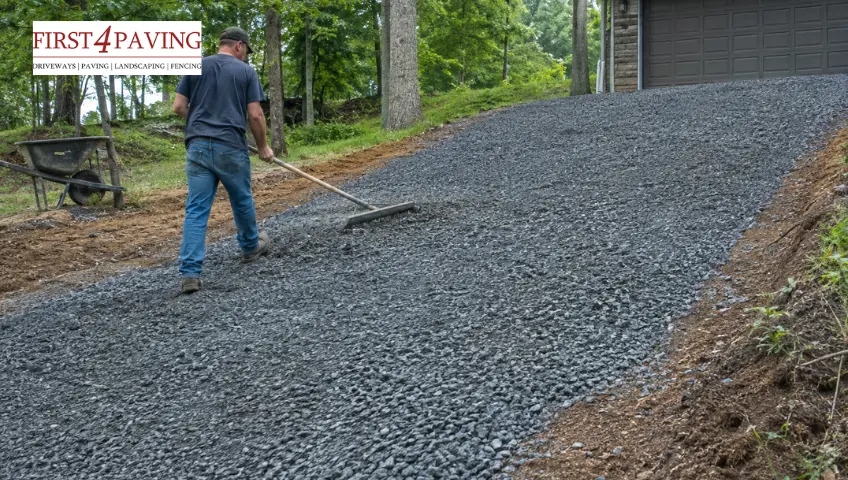
Yes, gravel can be used on a sloping driveway, but loose gravel is not suitable for every slope.
On a gentle gradient, a properly constructed gravel drive can work well. On a steeper slope, however, loose stone can move downhill under vehicle traffic and heavy rain. This can leave bare patches higher up the drive, piles of gravel at the bottom, and loose stone spilling onto the pavement or road.
The key is not simply choosing the right gravel. The gradient, ground preparation, drainage, edging and the way the gravel is retained all matter.
If you are considering a gravel driveway in Enfield or elsewhere in North London, it is worth assessing the slope before deciding which surface to use.
How Steep Is Too Steep for Gravel?
Gradient is usually expressed as a percentage, a ratio, or degrees. Here’s how the numbers compare and what they mean in practice for a driveway.
| Gradient | Ratio | What it means for gravel |
| 0–5% | Flatter than 1-in-20 | No stabilisation typically needed |
| 5–10% | 1-in-20 to 1-in-10 | Manageable; a stabilisation grid is still recommended for a neat, long-lasting finish |
| 10–15% | 1-in-10 to 1-in-6.7 | Gravel grid essential; edge restraints and drainage detailing become important |
| 15–20% | 1-in-6.7 to 1-in-5 | At the upper limit for gravel grid systems; deeper cells and angular aggregate required |
| Over 20% | Steeper than 1-in-5 | Gravel is not recommended; consider resin-bound gravel, block paving or tarmac |
How to work out your gradient: measure the rise (vertical height difference from top to bottom of the slope) and the run (horizontal length of the slope), then divide rise by run and multiply by 100 for a percentage. A driveway that rises 1.5 metres over a 10-metre run has a 15% gradient, right at the practical ceiling for gravel.
Not confident measuring it yourself? Our gravel driveway services in Enfield include a free, no-obligation slope survey.
Why Loose Gravel Fails on a Slope
Untreated gravel on a hill has two enemies: gravity and rain.
- Traffic and gravity push loose stones downhill under wheels and footfall, leaving bald patches at the top of the drive and a build-up at the bottom.
- Surface water speeds up as gradient increases, washing finer aggregate out along wheel tracks and creating ruts.
The result, left untreated, is a driveway that thins out at the top within a season or two, needs regular top-ups, and can become genuinely slippery for cars and pedestrians in wet or icy weather.
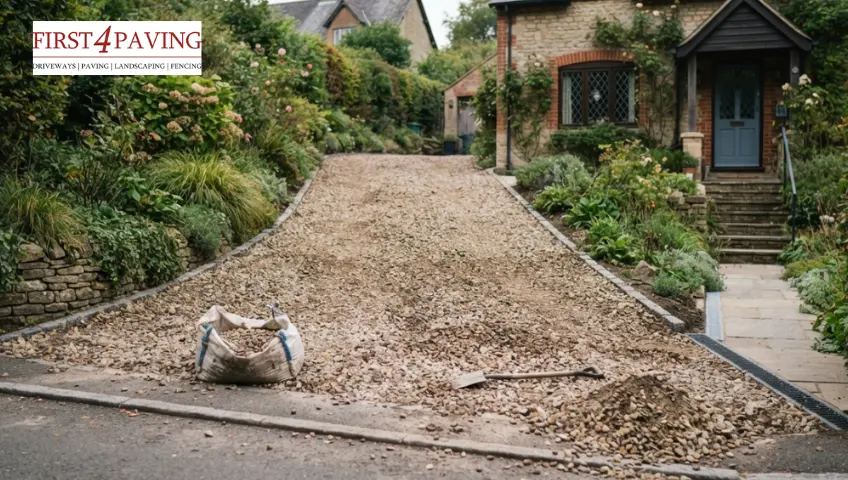
How Do You Stop Gravel Moving on a Slope?
If the gradient is suitable for gravel, there are several ways to improve its stability.
- Build a proper sub-base: The sub-base provides the structural foundation beneath the gravel. The ground should be excavated to the appropriate depth, prepared and compacted before the surface material is installed. A geotextile layer can also help separate the sub-base from the underlying soil. Government guidance recommends using a geotextile beneath permeable driveway construction and compacting the sub-base before installing the final surface. A strong foundation helps prevent the driveway from developing soft areas and ruts.
- Use suitable edging: Strong edging along the sides of the driveway helps keep the aggregate contained. This becomes particularly important where the driveway meets a pavement, road, lawn or planting area. The aim is to prevent the gravel from gradually spreading outside the intended driveway area.
- Consider gravel retention grids: Gravel retention systems can divide the surface into small sections, helping hold the aggregate in place. They can be particularly useful where a driveway has a noticeable gradient but still suits a gravel finish. However, a grid is not a magic solution for a very steep driveway; the underlying construction and drainage still need to be right.
- Deal with surface water: Drainage is one of the most important considerations on a sloping driveway. Water naturally wants to travel downhill. If the driveway slopes towards the house, this can create a much more serious problem than gravel movement. Where necessary, drainage channels, suitable falls and other drainage measures can be incorporated into the driveway design. Where a drive slopes towards a house, a drainage channel may be needed to collect excess water.
- Choose the aggregate carefully: Not all gravel behaves in exactly the same way. Rounded decorative gravel tends to move more easily because the individual stones can roll. More angular aggregate generally locks together better. The appearance you want also needs to be balanced against how the driveway will be used. For a driveway carrying regular vehicles, the surface should be selected as part of the complete driveway construction rather than simply chosen for colour.
Want it done right the first time?
Do You Need Planning Permission for a Sloping Gravel Driveway?
In England, gravel is classed as a permeable surface, so it’s generally exempt from the planning permission rules that apply to impermeable driveways over 5m². Since 2008, homeowners have needed permission to lay more than 5m² of impermeable surfacing (standard concrete, tarmac, sealed block paving) in a front garden if it drains straight to the road, but permeable surfaces, including gravel and gravel-grid systems, are exempt from that threshold regardless of size, because rainwater drains through them into the ground rather than running off.
A few points worth checking before you start:
- Conservation areas or listed buildings can carry Article 4 directions that remove permitted development rights, always worth a quick check with your local planning authority.
- Dropped kerb access across a public pavement needs separate permission from your local council, unrelated to the surfacing material itself.
- Steep drives onto a public road may need a visibility or gradient check from the council’s highways team for safety reasons, particularly near the junction with the road.
This is general guidance rather than legal advice. First 4 Paving can confirm the specifics for your property before work begins.
Drainage: Why It Matters More on a Slope
Because water accelerates as it runs downhill, drainage detailing is more important on a sloping gravel drive than a flat one. A well-designed installation keeps gravel and your driveway compliant with UK Sustainable Drainage Systems (SuDS) principles by:
- Using an open-graded, free-draining sub-base rather than a compacted, impermeable one
- Directing surface flow towards a soakaway, border or permeable margin rather than the highway
- Adding a shallow drainage channel or French drain at the base of long or steep runs
Done properly, a sloping gravel driveway can actually outperform a sealed surface for managing rainfall, since it lets water soak away naturally instead of sheeting off into the road.
When Gravel Isn’t the Right Choice
If your gradient is consistently above 20%, or the driveway sees frequent heavy vehicle traffic on a steep run, gravel, even stabilised, starts to struggle. In these cases, we’d usually recommend:
- Resin-bound gravel — keeps the appearance of loose stone, but the aggregate is bound into a solid, SuDS-compliant surface that copes with much steeper gradients and heavier use.
- Block paving — excellent grip and durability on steep drives, with a huge range of colours and patterns.
- Tarmac — the most cost-effective option for very steep or long driveways where drainage can be engineered separately.
Choosing between the last two usually comes down to block paving vs tarmac, weighing cost, upkeep and lifespan. A short site visit is usually enough to tell you which surface will perform best and look right for your particular slope.
Conclusion
A sloping driveway doesn’t rule out gravel, it just changes how the job needs to be done. Up to around 15–20% gradient, a correctly built gravel driveway with a solid sub-base, proper edging, a stabilisation grid and thought-out drainage will hold its shape, drain well, and stay low-maintenance for years. Beyond that, resin-bound gravel, block paving or tarmac will generally serve you better and save you from repeat top-ups down the line.
The only way to know for certain which option suits your driveway is to have the gradient properly assessed on site. That’s exactly what First 4 Paving does, for free, before any recommendation or quote is given, so you get a driveway specified for your slope, not a generic one.
Get Your Free, No-Obligation Gravel Driveway Quote
Serving Enfield, North London & Hertfordshire · No deposit needed · Nothing to pay until completion · 100% satisfaction guaranteed
FAQs
Can you put gravel on a steep driveway?
Gravel can work on driveways up to roughly 15–20% gradient if it’s installed with a gravel stabilisation grid, a proper sub-base and secure edge restraints. Above that, a bound surface such as resin-bound gravel or block paving is more reliable.
What is the maximum slope for a gravel driveway?
Most gravel stabilisation grid manufacturers set a maximum recommended gradient of around 15% (roughly 1-in-6.7), with some heavier-duty systems rated up to 20% (1-in-5) when paired with a deeper cell structure and angular aggregate.
Does gravel wash away on a sloping driveway?
Loose, unstabilised gravel will wash and migrate downhill in rain once the gradient passes around 5–10%. A stabilisation grid locks the aggregate in place and, combined with a free-draining sub-base, largely prevents this.
Is gravel or resin-bound gravel better for a sloping drive?
Gravel with a stabilisation grid works well up to a moderate gradient and costs less. Resin-bound gravel handles steeper gradients and heavier traffic more reliably, needs less ongoing maintenance, and typically lasts 15–25 years, at a higher upfront cost.