
Quick answer: Natural stone and clay pavers last the longest, 30 to 60+ years, followed by block paving (20–30 years), tarmac (15–25 years) and resin-bound surfaces (15–25 years). Gravel is the cheapest driveway option to lay, but, despite popular claims, is usually the shortest-lived option, lasting 5–15 years before it needs topping up or full replacement. On Hertfordshire’s heavy clay ground, the sub-base and drainage matter as much as the surface material itself.
If you searched this because you’re planning a driveway installation in Hertfordshire, St Albans, Watford, Hemel Hempstead, Hitchin, Hertford, Welwyn Garden City, Bishop’s Stortford, Borehamwood or Potters Bar, here’s the full picture, including the SUDS drainage rules that apply across Hertfordshire in 2026.
Driveway lifespan at a glance
| Driveway type | Typical lifespan | Cost per m² (2026) | Maintenance | Permeable? |
|---|---|---|---|---|
| Natural stone (granite, sandstone) | 30–60+ years | £130–£250 | Low | Depends on laying method |
| Block paving | 20–30 years | £40–£134 | Medium (re-sanding, weeding) | Yes, if permeable blocks used |
| Resin bound | 15–25 years | £40–£100 | Low | Yes (resin-bound only, not resin-bonded) |
| Tarmac | 15–25 years | £44–£107 | Medium (resealing every 3–5 years) | No, unless porous tarmac |
| Concrete | 20–30+ years | £50–£90 | Very low | No, unless permeable concrete |
| Gravel | 5–15 years | £15–£40 | High (regular raking, topping up) | Yes |
So, Does a Gravel Driveway Really Last a Lifetime in Hertfordshire?
It’s a common claim, and gravel does have real advantages: it’s the cheapest driveway surface to install, it’s naturally permeable (which helps comply with Hertfordshire’s SUDS drainage rules), and there is no cracking or resurfacing to worry about. But “lasting a lifetime” only really applies to the sub-base underneath; the loose stone on top migrates, scatters onto lawns and paths, and needs regular topping up every few years. Most independent comparisons put gravel’s practical lifespan at 5–15 years before a full refresh, making it one of the shorter-lived options rather than the longest, unless you’re comparing purely on cost rather than years of service.
If genuine longevity with minimal top-ups is the priority, block paving and natural stone are the materials that consistently outperform gravel over a 20-plus year horizon.
The Driveway Materials Compared
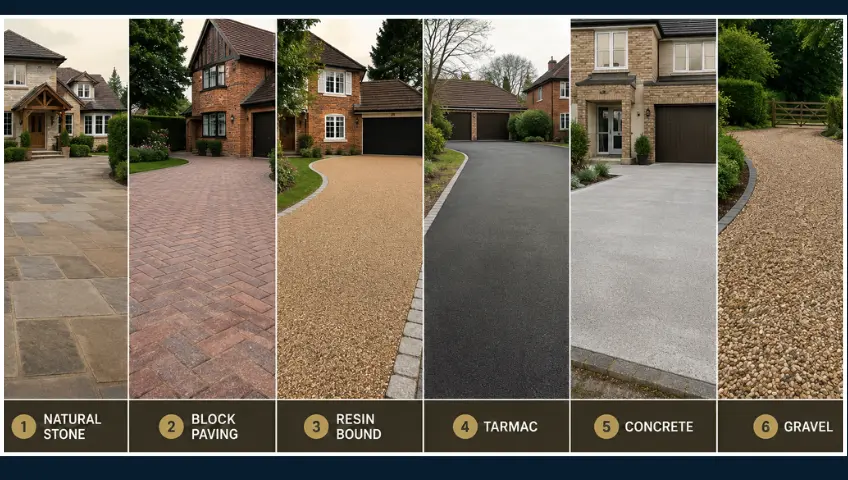
1. Natural stone and clay pavers — longest lifespan
Granite setts, Indian sandstone, and clay pavers are among the most durable driveway surfaces available, often lasting 30–60 years or more. Granite is the toughest and least porous; sandstone is popular and slightly more affordable but needs gentler, low-pressure cleaning to avoid surface wear. It’s also the highest upfront cost, so it suits homeowners prioritising longevity and kerb appeal over initial spend.
2. Block paving — the durability all-rounder
Block paving typically lasts 20–30 years and is one of the easiest surfaces to repair — a cracked or oil-stained block can be lifted and replaced individually without disturbing the rest of the drive. It needs periodic re-sanding of the joints and occasional weed control, and permeable block paving systems can meet Hertfordshire’s drainage requirements without extra soakaways. This is why block paving remains the most requested driveway type across Hertfordshire towns like St Albans and Hertford, where period and new-build properties alike suit its design flexibility. If you’re at the planning stage, it helps to understand the process for laying a block paving driveway before getting quotes.
3. Resin bound driveways — low maintenance, modern finish
Resin bound surfaces last 15–25 years with proper installation and need little more than an annual pressure wash. Resin-bonded finishes wear out much sooner, and our guide to how long resin driveways last explains the difference. Because resin-bound surfacing is naturally permeable, it typically complies with SUDS drainage guidance without requiring planning permission. Lifespan depends heavily on installation quality — a poorly prepared base is the most common cause of early resin failure.
4. Tarmac — the practical, budget-friendly workhorse
Tarmac driveways last 15–25 years on a well-prepared sub-base and are the quickest to install, often in a day or two. Resealing every 3–5 years extends the surface life significantly. Tarmac is not permeable, so on a front driveway over 5m², it usually requires either planning permission or drainage to a permeable area.
5. Concrete — durable but less common on Hertfordshire drives
Plain or patterned concrete can last 20–30+ years with virtually no maintenance, but it’s less frequently chosen for UK driveways than block paving or tarmac, and standard concrete is impermeable, bringing it under the same SUDS considerations as tarmac.
6. Gravel — cheapest, most flexible, shortest-lived
Best suited to low-traffic drives, rural or period properties, and homeowners who want a permeable surface without extra drainage work. Expect to rake and top up every few years, with a full refresh needed roughly every 5–15 years.
What Actually Determines How Long a Driveway Lasts in Hertfordshire?
Material choice is only part of the story. Across Hertfordshire, three factors matter just as much:
- The sub-base. Hertfordshire sits largely on chalk with clay-rich topsoil in many areas, particularly around Hertford, Ware and the Lea Valley. Clay holds water, swells in wet weather and shrinks in dry spells, which can crack a thin or poorly compacted sub-base within a few winters regardless of the surface material.
- Drainage and SUDS compliance. Since 2008, any new or replacement front driveway in England over 5m² must either use a permeable surface (gravel, permeable block paving, resin bound) or drain rainwater to a lawn, border or soakaway rather than onto the road. Hertfordshire district and borough councils — including St Albans City & District Council, Watford Borough Council and Dacorum Borough Council — do enforce breaches, usually following runoff complaints. It’s worth reading up on the minimum requirements a driveway needs to meet before you finalise a design.
- Installation quality. A correctly excavated and compacted sub-base is consistently cited as the single biggest factor in whether a driveway reaches the top or bottom of its expected lifespan range.
Do I need Planning Permission for a Driveway in Hertfordshire?
Most Hertfordshire homeowners will not need planning permission for a driveway, provided:
- the surface is permeable (gravel, permeable block paving, or resin bound)
- rainwater drains naturally to a garden, border or soakaway rather than onto the public highway.
You will usually need separate approval, a dropped kerb licence from Hertfordshire County Council, if you’re creating new vehicle access onto a road, and this should be arranged before installation begins. Extra rules can apply to listed buildings or properties in a conservation area, so it’s worth checking with your local planning department first if you’re in one of Hertfordshire’s historic town centres such as St Albans or Hertford.
Which driveway is right for your Hertfordshire property?
- Want maximum lifespan and don’t mind the higher cost? Natural stone or granite setts.
- Want the best balance of durability, repairability and kerb appeal? Block paving.
- Want a modern, low-maintenance, permeable finish? Resin bound.
- Want the most budget-friendly, fastest install for a larger drive? Tarmac.
- Want the cheapest option and don’t mind periodic top-ups? Gravel.
Conclusion:
When it comes to the longest-lasting driveway Hertfordshire homeowners can invest in, natural stone and clay pavers remain the clear winners, often providing 30–60 years or more of reliable performance. However, lifespan is only part of the decision. Factors such as budget, maintenance requirements, drainage compliance, and the condition of the sub-base can have just as much impact on long-term value.
For many Hertfordshire properties, block paving offers the best balance of durability, appearance, and repairability, while resin-bound surfaces provide a modern, low-maintenance alternative that also meets current SUDS drainage requirements. Whatever material you choose, investing in proper ground preparation and professional installation will do more to extend the life of your driveway than the surface material alone.
If you’re planning a new driveway in Hertfordshire, seeking expert advice before installation can help ensure it remains attractive, compliant, and durable for decades to come.
FAQs
Is block paving or tarmac better for a Hertfordshire driveway?
Block paving generally lasts longer (20–30 years vs. 15–25 for tarmac) and is easier to repair individual sections of, while tarmac installs faster and costs less upfront — a good fit for larger, budget-conscious drives.
Do I need planning permission for a new driveway in Hertfordshire?
Only if the surface is over 5m², impermeable, and rainwater can’t drain naturally to a lawn, border or soakaway. Permeable surfaces like gravel, permeable block paving and resin bound are generally exempt.
What’s the most durable driveway for clay soil?
Any surface can perform well on clay soil provided the sub-base is excavated deep enough and properly compacted with adequate drainage — this matters more than the surface material itself in clay-heavy parts of Hertfordshire.